Saturday, August 3, 2013

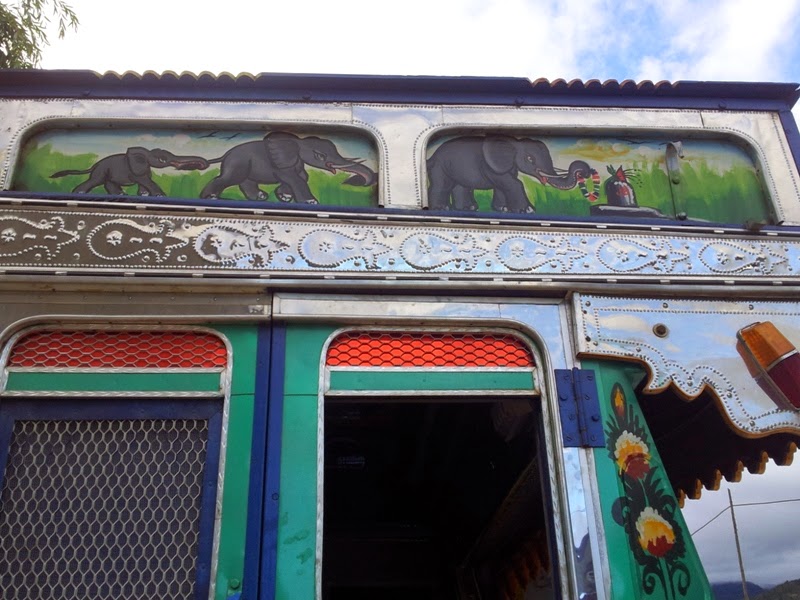
Truckspotting

You're driving on a narrow, potholed road, slimy with wet mud, winding around sharp corners that hug the sides of the Himalayan mountains, and suddenly a horn blares and a Tata truck comes barreling towards you!

Its a heart in your mouth moment as you pull to the side to let the truck pass on what must be the finest edge of the road. Only millimetres of dirt and dust protect the driver from falling into the abyss! And as he passes you can't help but admire the colour and dingly-dangly ribbons and decorations that adorn the truck, and understand the need for all the religious imagery. Life on the roads of India and Bhutan is about facing life and death on a daily basis.

I've been fascinated with these enormous plundering trucks since my days as a traveller in India. Travelling on overnight buses through the Himalayas was the only way to cover the long distances between places like Dharamsala and Delhi, or from India to Kathmandu.

Picture this: you settle in for the night and get comfortable on the seat that jumps a metre every time you go over a bump, wrap a shawl around you as the cold night air creeps through the window that doesn't close properly, and slowly drift off to sleep. 

And then Honk! Honk! Screech! The bus lurches and stops as a noisy Tata truck asserts its right to pass, often with sparkly flashing lights and Hindi music blaring. You wake abruptly, realise all is well, and try to doze back to sleep again. And on and on goes the night!

Living in my village here in Bhutan, I've sought out colour, variety and art wherever it comes, and so I started to photograph the trucks I see pass through here. It seems that Chumey is a popular place for drivers to recharge at one of the local 'General Shop cum Bars' - hopefully not too much beer and mostly rice and ema-datsi (or am I dreaming?).

I'm not the first to have an urge to document the Tata trucks of the Indian subcontinent. Here is a link to a fascinating book I'd love to get my hands on some day: http://www.hornpleaseindia.com/ with gorgeous images of the trucks, their drivers and also the story of their lives on the road.

Here is just a sample of the trucks I have seen here in Bhutan, their Buddhist imagery contrasting with the predominantly Hindu decorations seen in India.


I have some ideas circling my head of how I can use some of these images when I get home to create some type of a photo collage wall, or even to inspire a painting, if I have time to paint again! 

And, let me forewarn you that in an upcoming blog I have another collection of public art photos to share - more of an M-rated variety! I'm just letting you know - you're either intrigued or will know its not for you!

Thursday, August 1, 2013

Puta Lotta Love in your Buckwheat Noodles!

We are living in the gastronomic heart of Bhutan. In nearby Chamkar a Swiss man by the name of Fritz Maurer has set up a number of flourishing food industries. We are fortunate to be able to buy a couple of varieties of real Swiss cheese, local apple juice and Red Panda weiss beer. Additionally behind our home is a milk processing plant that produces homemade datsi cheese.
Finally our region is coming into its own with harvest season upon us – local people are toiling in the fields to gather their crops of mainly potatoes, but fruit trees are also yielding long awaited apples, peaches and plums. In early summer we enjoyed many a weekend collecting abundant wild strawberries, and just as they have finished my students have shown us the wild orange-coloured raspberries that grow all around. They taste similar to but sweeter than raspberries at home.
We had a taste for the bare-bones availability of fresh foods when we first arrived and so we have to enjoy the abundance while it lasts – I’m not looking forward to seeing all the fruits and vegetables becoming sparse as the weather cools.
Across Bhutan there are a few foods that really define cuisine here – particularly ema-datsi (chillies and cheese), kewa-datsi (potatoes, chilli and cheese) and shamu-datsi (mushroom cheese and chilli) with red rice, ezay (chilli salsa) and momos (vegetable or meat dumplings). Bumthang is famous also for producing buckwheat which is made into pancakes and noodles called ‘puta’.
Before I tasted puta for the first time here I imagined it to be something like Japanese soba noodles which are a family favourite. Their long, thin, silky strands and subtle flavour make them one of my favourite comfort foods. Puta are as different as they possibly can be, while still being noodles made of buckwheat flour! Rustic, thick, chewy and strongly flavoured with bitter buckwheat, they might take some getting used to! Depending on where you eat them (we’ve sampled them many times at nice hotels, homes and outdoor festivals) they can be fairly inedible through to delicious.
What makes puta special is not just the noodles themselves but the way they are traditionally prepared cold with a simple dressing of chives and Szechuan pepper. Locals also like to dunk them in a drink of cold churned yoghurt, but I prefer to keep them separate.
Recently while staying at the River Lodge in Chamkar I asked the owner’s daughter Yeshi to show me how she prepares puta – and she very kindly gave me a personal cooking class. I haven’t had a chance to make them at home myself yet as I don’t have a noodle press to make the noodles. It seems like these aren’t easily available here as anyone who wants one puts in an order when friends or family visit Thailand. Guess what I’ll be looking to buy when we hit Bangkok in December?! An alternative would be a pasta machine.
The basic dough mix is simple: buckwheat flour, water and eggs. Yeshi made a large quantity for a crowd, but suggested to make a smaller quantity by using two or three cups of flour and just one egg. The dough is made fairly firm and left to rest a while, then pressed through the noodle mould.
Noodles coming out of the noodle press.


A plate full of noodles ready to cook.


The process of making puta is slow when making a large quantity. Yeshi pressed just a small bowlful through the noodle maker at a time, then quickly immersed them in a large pot of boiling water. They only take a minute or two to cook – when they rise to the surface they are done and scooped out with a sieve and immediately placed in a bowl of cold water. Yeshi slowly and patiently separated the noodles as they cooled in the water and finally drained them and put them in a large bowl. The process was repeated several times until all the dough had been used.
Cook briefly in boiling water.


Yeshi is ready to add the chives to the cooked and cooled noodles.


I loved the pace in Yeshi’s kitchen – she worked methodically, but had time to talk and explain what she was doing, never rushing the process of preparing her noodles with a lot of love.
Once all the noodles had been cooked and cooled, Yeshi crushed some Szechuan pepper corns in a mortar and pestle. She then heated some vegetable oil in a large wok and added what I think were garlic chives (chopped into 2 inch lengths) briefly, just to impart flavour to the oil. This oil and chives was then poured over the noodles and gently mixed through with the hands. Then a couple of teaspoons of Szechuan pepper were sprinkled over and a little salt and the dish was done. Just like that.

Szechuan peppercorns.


When we stayed at Gangtey Palace I watched this lady collecting Szechuan peppercorns from these bushes.


Although aspects of the dish are laborious, it comes together quickly and I look forward to learn how to make these so I can share them with friends at home.
Please excuse the lack of ingredients list and quantities. Recipes like these are not written down here but passed from mother to daughter and each cook makes the recipe to their own taste. Experiment and have a try and see what you think!


Wednesday, July 31, 2013

July Photo-a-day

The most exciting thing that happened to me today is that without any fanfare, explanation or reason, our broadband internet started working again. For six or more weeks we've been out a connection except for about three random days in that time, and I can't tell you how frustrating it is!

We have tried every avenue to fix the problem including buying a new Bhutanese modem (to replace our flash Australian wifi modem), numerous visits from Bhutan Telecom to our house, and numerous visits from Bob to the Bhutan Telecom office in Chamkar. In the end an assumption was made by all that it was our computer that was the problem, and Bob has spent hours over the past few days using the computer at the post office to research buying a new computer to be shipped here from overseas.

And then, on a whim, I plugged in the modem this morning and it worked. I have no idea why! No one here can give any explanation, and in fact when I questioned my colleagues today they said "Oh yes, my internet hasn't been working for a while either", but no one seems too disturbed about it!

So I am very happy to post my photos today, quite a few of which I wasn't able to upload onto the facebook page through the month. Is it really going to be August tomorrow?


1 - Happiness
Happiness is good friends, good food, beautiful scenery.

 
2 - Shoes
Shoes at Semtokha Dzong

3 - Cold
When we reached the ridge above Tharpa Ling, the wind was cold!

4 - Red, White and Blue
Om Mani Padme Hum painted on the rock wall at a temple above Tharpa Ling

5 - Love
We stopped at Lobesa en route to Thimphu to buy sweets and icecreams as an afternoon pick-me-up - 8 hours of driving down, 3 to go!

6. Fave Smell
Waking up in Matt and Lucy's place in Chemgang to the smell of fresh pancakes and my favourite Earl Grey Tea!

7 - Where you are
Pedestrian Day in Thimphu, the streets are closed so people can walk and play in the streets of the capital every month!

8. Path
We stayed at Gangtey Palace in Paro with enchanted gardens and lovely cobblestone paths.

9 - Three Things
Three water-powered prayer wheels on the walk up to Tiger's Nest.

10 - Smooth
The slide at the children's playground in Thimphu.

11- I wore this
Bob bought me a new double dorji amulet at Paro Dzong to add to my growing collection of blessing strings.

12 - A Bad Habit
This lady is preparing 'doma' - betel nut - to sell. It has a mild intoxicating effect to those (most Bhutanese) who chew it through the day.

13 - 4 O'Clock
What a lovely moment to capture forever! Enjoying tea and biscuits on the grass in the afternoon sunshine with Senge at Phobjika.


14 - Edible
This freshly slaughtered meat is being put out to dry in the sun. This is edible for Bhutanese, but as it was swarming with flies I'm glad to be vegetarian!

15 - Outside the Window
Looking through the windscreen of our hired car as we go over the Lowa-La pass.

16 - Bottle
We came back from Thimphu with a couple of boxes of luxury imported foods to last the final 5  months. Will two bottles of olives get us through?

17 - Inspiration
School began with two days of gardening - here the students are planting hazelnut seedlings which is the new cash crop Bhutan hopes to make money with in the future.

18 - Number
The Dzongkha number chart on my classroom wall.
19 - Building
This photo is not from the day, but I couldn't resist showing one of the worlds most impressive, unusual and fascinating buildings - Tiger's Nest Monastery.

20 - Hot
I have become addicted to chilli and even make chilli fried rice for breakfast most mornings!

21 - Fave food
It's not my favourite food in the world (could be a tight competition between Japanese and Indian), but these are my favourite Bhutanese foods - momos, kewadatsi and puris.

22 - Grey
Crossing the grey bridge in grey weather to the grey stone house where one of our teachers was hosting a baby shower after school.

23 - I Drew This
Inspirational signs I made for the library door.

24 - D is for...
Door - the High School Library Door is beautifully decorated.

25 - Ground
Students cutting the grass by hand with sickles - with all the monsoon rain the grass is growing quicker than they can cut it so they are out every morning doing this before school.

26 - Everyday
Everyday in Bhutanese homes, schools, temples etc water bowls are offered to the Buddha. Each bowl represents a different precious thing to offer the Buddha such as beautiful fragrance.

27 - Black and White
I had wanting to photograph this wooden ladder that leads up to one of our neighbour's homes.

28 - This is new
These potatoes were freshly harvested by one of my student's families from their field over the road and she brought us these at the end of the day.

29 - Perspective
This sunflower appears to be towering over the Himalayas in the background.
30 - Friendship
The children here all walk to and from home together in small friendship groups. I remember doing this when I was little.
 
31 - Workspace
So happy that our home workspace is in action again - for how long is anyone's guess!
 

Here's to staying online for at least a few days so we can catch up with everyone!