Monday, August 12, 2013

Behind the scenes at the Monsoon Football Tournament


It is football season in Bhutan. To clarify,  it is football as in the ‘world game’ soccer. This weekend, the King’s Cup was concluded at Changlimithang in Thimphu with Nepali team Manang Marsyangdi edging out local team Yeedzin for the winner's trophy.  

It is curious to me as to why football season coincides with monsoon – there can only be one outcome – mud! I’ll be frank with you, although I played soccer in high school, I was more of a liability to my team than an asset, so I recommend you read Matt’s
(fellow Aussie BCF teacher) blog if you want to get the lowdown on football in Bhutan. Football in Bhutan seems to predominantly be a men’s game while women take a supporting role, so if you choose to read further you’ll find out more about what we ate than how many goals were scored by which team!

Chumey MSS is hosting the regional Monsoon Football tournament for the next three weeks, and Saturday afternoon was the first kick-off. As soon as Saturday morning lessons finished, I joined the other ladies in one of the science labs to help cook up a storm. The snacks we made are to sell to the audience and participants and raise money. The school has embarked upon an ambitious project of building 12 religious statues for the school hall with an estimated cost of about $14000. That is an enormous amount of money anywhere in the world, and it is eye-opening to say the least that the priority of the school is to fund statues while I see so much educational need, but in Bhutan obviously priorities are vastly different. So I wonder how far the proceeds of all the snacks we’re making will go?

If you know me, you know I love cooking and food, and so I really relished the opportunity to get involved in learning to cook all the Bhutanese favourite snacks. On the menu were: chilli chop (battered deep fried chillies), aloo chop (mashed spiced potato battered and fried), vegetable momos (steamed vegetable dumplings) finger chips (deep fried coloured ‘noodles’ that are crispy and moorish, a bit like prawn crackers) and ezay (chilli salsa). And no social function in Bhutan would be without doma (betel nut)!

Finger chips.
 

My first role was to help with packaging up the doma. Doma is a curiosity to me – I’m not interested to try it as you end up with a mouth of crushed betel nut and dripping with red saliva, and yet it must have a strong appeal as most adults here chew doma throughout the day (even while teaching!) and even children take it too they tell me!

Preparing the doma - chopping the nuts.


So we rolled four leaves smeared with lime paste with four pieces of betel nut in a piece of recycled note paper (watch out students – if you leave your note books lying around they will be put to good use!). They sell for 10 ngultrums (20c) and as part of social life here, everyone seems to have a little packet of doma hidden in their kira or gho, ready to share around.

Next I joined the momo making production line. Already one of the teacher’s husbands had come in to lend his elbow grease to the task of mixing and kneading the dough. I was told the dough is just plain flour and water, and it was kneaded to a soft, pliable consistency and left to rest while the filling was prepared.


Making the momo filling.

Making the circles of dough for the momos.

It should look just like this!

Happily making the momos!

 
Ready to steam.
 

The filling was made from chopped cabbage, onion, ginger, salt and ‘tasting powder’ which I found out was MSG. Some mashed potato was added and then quite a lot of vegetable oil which created a very wet mix. Earlier this week I watched the lady in our ‘aloo chop shop’ make momos and she added garlic, coriander and processed cheese to her mix. The mix was stirred carefully by hand until all the ingredients were amalgamated.

Miss Rajini showed me once how she folds momos and that was my initiation into the big new world of momo making! It is true that I dabbled in momo making at home for our goodbye party, and Miss Rajini’s style was similar to what I learned watching youtube, so I was on my way!

The dough was so soft and supple to use, and rolled relatively thickly too, not wafer thin like the gowgee wrappers I had used to make momos at home which are quite hard from refrigeration. I’d say it was 100 times easier to make momos with the home made dough as they were larger, softer and thicker. Well worth the effort to make. It was fascinating to see that all the women who folded momos had a different technique, and their momos ended up looking quite different. Some were crescent shape, some pleated on the top to make an oval shape.

It’s a funny thing to sit cross legged on the floor, dressed in a fine kira to get into the messy work of cooking, but I really enjoyed myself! Conversation flowed around me in Dzongkha. If I tuned in I could understand some of what was said and I pounced on any English word in a sentence to make meaning.


A very friendly, communal way of cooking.


As a group of about six of us made momos – three rolling the dough and cutting it into circles and three filling them, another group of hard workers were onto the task of making chilli chop.

These are a favourite snack food here and cost 10 ngultrums (20c) for three. Half a large chilli, which is medium hot, is dipped in a batter made from mostly besan (chickpea) flour mixed with some plain flour, baking powder, salt and water. It is then dropped in hot oil and deep fried til golden brown and a bit puffy. The ladies had a large bucket of chillies and it took them literally hours to batter and fry them all.

The makings of chilli chop.

Mmm mmm! Chilli chop!


Meanwhile another group were working on aloo chop.  An enormous pot of unpeeled potatoes were boiled til well cooked and then when cooled somewhat their skins were peeled off. These were mashed and red chilli powder added along with salt, chopped onions and that magical ‘tasting powder’. I was told that chopped coriander leaves are a nice addition if available. These were then formed into flat rounds about 5 cm in diameter and 1cm thick.

Sliced onion is added to the mashed potato.

We made hundreds and hundreds of aloo chop!
 

These too were dipped in the besan flour mix and deep fried and looked delicious, quite like a potato scallop that we enjoy in Australia.

The condiment for all these treats is ezay, and the one made today is the same that is usually served with momos here and is different to the recipe we learned in Thimphu and that I posted here.

This time a very large quantity of red chilli powder was mixed with chopped tomato, sliced onion, salt, water and ‘tasting powder’ (I had no idea we were eating so much MSG in Bhutan?!). To this, hot cooking oil was added to give it something special and it was mixed very bravely by hand (please do not touch your eyes after doing this!).


You can see I’ve managed to write a lot without even mentioning the actual game of football!

Finally I had a chance to go and check out the action. While the Chumey MSS boys played against boys from the nearby Vocational Training Institute, my young students were having a makeshift game on the puddly ‘basketball’ court. They don’t call it monsoon football for nothing. The main field was a mud bath and I suspect that this is just the beginning – by the end of three weeks of daily games it will just be slush!

Shop set up to sell all our goodies.

The boys seemed to be enjoying all the food more than the football!


The little school boys had their own game.

Training session.

Karma's little brother looked so cute, although she wasn't enjoying the responsibility of carrying him round!


I've been requested to help everyday with catering, and at some point I'm sure I'll sit down and actually watch a game!


Friday, August 9, 2013

Ten things I love about our life in Bhutan... and what I miss about Australia

We have passed the half-way mark in our year in Bhutan and have about four and a half months left to enjoy.

I wanted to write down and share the things that are really special and unique in our simple life here. There may not be a time in our life again like this, so it’s important to smell the roses!

1.       Time – even though I work full-time (five and a half days a week) I still seem to have more time than I had at home. I wake up and have a couple of hours to enjoy the day, even make pancakes before getting ready for school. There is no time wasted commuting to work, watching television, and lately little time wasted cruising the internet as it hasn’t been working reliably. I have time to spend with the kids even though I am a working mum, I have time to enjoy cooking, reading, an occasional walk. Life never feels rushed; we live at a leisurely pace.

A love letter from Remy - 'I love you from Remy'


2.      Convenience – When I opened the fridge at 6am the other morning ready to make a cake to take to a picnic, there were no eggs. No problem! Bob went for a walk and found a dozen eggs at one of the local shops a minute’s walk over the road. Shops are operated at the front of people’s homes, so as long as someone’s awake they are open. At any time we can run out to buy milk, cheese or more chillies!

3.       Walking to school – it takes me only five leisurely minutes (or ten with Xavier) to walk to school. On the way I pass villagers who always smile and offer a Kuzuzangpo! or Hello Madam! Even toddlers wave and say hello and know our names. Day by day the scenery changes subtly with the seasons – from bare and brown in winter to lush and green right now. Planting and harvesting and the daily chores all take place as I walk past.

Village houses we pass on way to school.

Most days there are horses and cows grazing along the side of the road on the way to school.

Walking to school with Xavier.


4.       No temptations – at home we are bombarded by advertising in all its forms: junk mail, television, window shopping, emails etc. It’s not hard to be convinced that you really need that new whats-a-ma-callit and rush out to buy. Here the only advertising we see is on Indian cable television – and ironically most of the products are not available here – so that is that. The western clothes that are available in Chamkar or even Thimphu are not to my taste – mainly cheap synthetic imports from China with strange English all over them, so again I’m not moved.

5.       Meeting for lunch – every school day Xavier and I meet Bob and Remy for lunch. Sometimes Bob packs a picnic and meets us at school and the boys have a play with the school kids. Many days we come home and Bob has something warm and tasty ready and a cup of tea. Other days we go to one of the two unnamed or signed huts across from the school that sell snacks – cheese momos or aloo chop (deep fried potato balls) or puri and sabji (fried flat bread and vegetable curry), washed down with a cup of tea and a chat with whoever is also there for lunch.

Bob and Remy riding to school to meet us (Bob made a wooden child seat for Remy as none were available here!)

 
6.     Living in pristine nature - we breathe fresh, clean mountain air, and our eyes are greeted with such beautiful scenery every day. A raging river passes near our house, travelling from the high Tibetan plateau on its journey to India and beyond. The glory of the Himalayas is right on our doorstep and there are many places to walk in every direction from our home. We've been gorging lately on a few varieties of wild berries, and I think it is wonderful for the boys to have this opportunity which is not part of city life.

A favourite place to play is down by the river.

Remy enjoys a simple game of throwing big rocks in the river!

Walking to the monastery up above our home.


7.       Meeting new and interesting people - this year has opened up our lives to so many new friends. We know just about every person in Chumey village and are always greeted with respect and friendliness wherever we go. The friendships we've struck up with our fellow BCF teachers and other foreigners in the country, as often happens when one is an expatriate, are close and ones we'll treasure for the rest of our lives.

Tshewang (helping cut grass at school) is the boy's favourite friend.

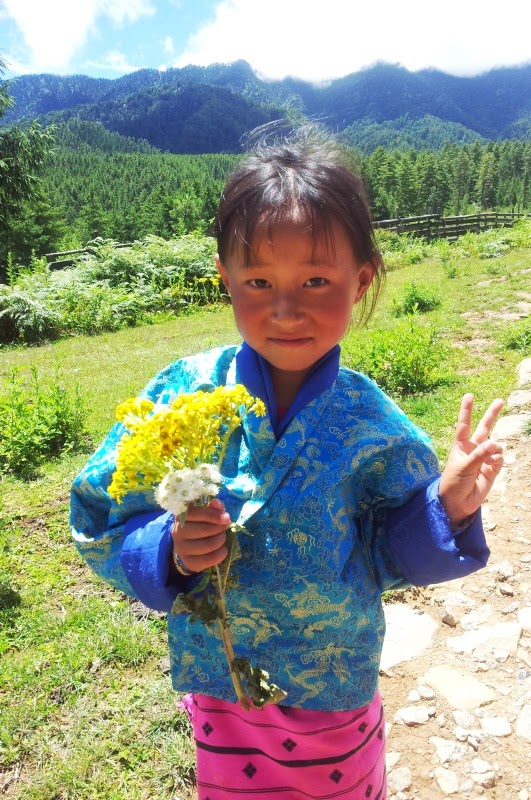
Every day kids from all different classes bring me special presents. Karma painted a beautiful rainbow.

Karma and Rozi organised a picnic for us at our nearby monastery.

Rozi looking very beautiful!

Rozi Naa so colourful and pretty.

Karma is one of Xavier's special 'girlfriends'.

Sharing a picnic in the enchanted forest.

What's the time Mr Wolf?

I love these kids, and their laughter and antics make me smile everyday.
All our BCF buddies - not sure who took this photo on the day?


8.        Good Health - in planning this trip my primary concern was for the children's health living in a 'developing country'. Touch wood, the boys haven't even had a single cough or cold or year. Maybe its the mountain air, the simple unprocessed food we eat, the lack of urban air-conditioned environments, the low population density and regularly having a long good night's sleep, but we and everyone else here seems to be in robust good health. I pray for this to continue for the next few months!

In excellent health, on one of our shopping trips to Chamkar they had to just strike a pose!

I took this photo of Xavier yesterday, he has grown so much.
Feeling tip-top!


9.        Life-long learning  - Here everyday brings something new. New food, new language to learn, new challenges at school, new opportunities, new people. We are living outside our comfort zone and for all of us it is an opportunity to learn and grow.

Buddhist philosophies are a great source of inspiration.


10. Living with seasons - coming from a tropical climate that doesn't change much in the course of a year, it is fascinating to watch the day by change in temperature and corresponding change in scenery and even smells of the village and the accompanying festivals and rituals that are part of traditional life. I can imagine the feeling of security and peace this brings for people who have lived here all their lives.

Beautiful hibiscus (?) in bloom at school.

Students recently planted 800 hazelnut saplings.

Summer abundance at the markets.

Local gardens are a riot of colour in summer.

My favourite flowers, sunflowers, are everywhere!

Strings of 'chugo' dried cheese, drying in the sun.
 
 
This post wouldn’t be complete without listing a few of the things that I miss from home and know I will appreciate all the more after our year here.

1.       Friends and Family – there’s nothing to replace the relationships we have with our friends and family at home. We are lucky to have a large extended family which finds lots of opportunities to get together for a picnic or a barbecue on the weekend. And I miss my girl friends who I used to hang out with through the week with the kids – talking, drinking coffee and more talking. I miss the friendships and camaraderie of my teaching colleagues in Australia too – finding ways to learn from each other and improve our teaching and share what’s working (or not working).

2.       English – I miss being in a place where English is the main language spoken on all occasions. We are lucky here that at least at school everyone can converse in English, but when it comes down to it, at every function we attend either at school or socially, Dzongkha or Bumthap is the language spoken and we miss out on understanding, and also interacting. I love going to social gatherings with the ladies, but feel sad to be the wallflower watching as everyone else catches up and I must depend on someone translating for me to be part of the conversation.

3.       Reliable running water and electricity – something we don’t give a second thought in Australia. There is always water, hot and cold, day and night, and there is always power. Here when I wake up I feel a little surge of joy when I realise that we have both water and power – a great start to a day. Bob has carried buckets of water up three flights of stairs more often than he cares to count just so we can wash the dishes and flush the toilet. We have learned to live with it, but I won’t miss the inconvenience.

4.       Warmth – I am a summer girl, I love the feel of sun and sweat on my skin, love to wear shorts and singlets and summer dresses with sandals. Even here in Bumthang, in summer the temperature seems to hover around 22- 24 degrees. It’s pleasant and comfortable but not hot. I can’t wait to swim in the sea, swim in our pool and feel the contrast of the crisp refreshing coolness on a hot day.

5.       Food – I have really discovered some new favourite foods here, and have perhaps developed a life-long addiction to chilli, but when it comes down to it, I miss the food of home. Breakfast is the hardest meal of the day for me here – no fresh wholemeal/sourdough/rye bread, no thick greek yoghurt, no homemade granola (I tried to make it but it’s not the same). Our Burleigh Farmer’s Markets are abundant every weekend with every type of fruit and vegetable you can think of. Supermarkets sell all sorts of products that make cooking a breeze, and I also love browsing the Asian supermarkets for interesting ingredients to bring back memories of holidays in Asia. So much choice and variety!


I think we are thoroughly blessed in our life to be able to take the opportunity for one year to step out of all that is familiar and comfortable to experience a completely different way of life. As you can see, there are many things that make life here so special and have allowed us to really spend quality time together as a family. Nearly every  night I have a dream of being home doing something mundane and wishing I was back in Bhutan, so I know that Bhutan is leaving a deep impression on my psyche.

How lucky we are though, to call Australia home – there is no doubt we are the ‘lucky’ country and we’ve all had a chance to have a wake-up call and realise how good we have it there. It will be interesting to see how we make subtle changes to life in Australia to bring a little of the magic of Bhutan with us.